

































Concrete admixtures play an important role in modern construction. By modifying the properties of fresh or hardened concrete, the right admixture can improve workability, control setting time, enhance durability, reduce construction risks, and help concrete meet specific project requirements.
However, different admixtures perform different functions. Choosing the wrong product or using an unsuitable dosage may lead to problems such as segregation, bleeding, delayed strength development, or reduced compressive strength.
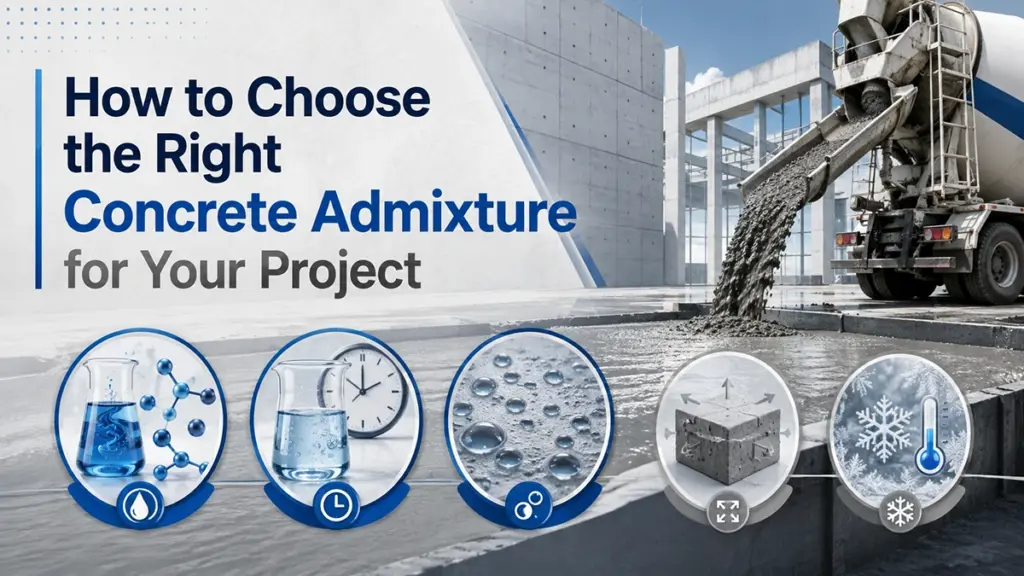
Among the most commonly used concrete admixtures are Superplasticizers, Retarders, Air Entraining Agents, Expansive Agents, and Antifreeze Admixtures. Understanding their functions and suitable applications is the first step toward selecting the right solution for your concrete project.
1. Superplasticizer: Improve Flowability and Reduce Water Demand
A Superplasticizer is one of the most widely used admixtures in modern concrete production. Its main function is to significantly improve concrete flowability while reducing the amount of mixing water required.
Without a Superplasticizer, increasing concrete fluidity usually requires additional water. However, too much water increases the water-cement ratio, which can negatively affect concrete strength and durability.
By using a suitable Superplasticizer, concrete producers can achieve better workability without unnecessarily increasing water content.
Typical benefits include:
- Improved concrete flowability
- Reduced water demand
- Lower water-cement ratio
- Higher compressive strength
- Better pumping and placing performance
- Improved density and durability
Superplasticizers are especially suitable for ready-mix concrete, pumped concrete, high-strength concrete, precast concrete, and self-compacting concrete.
However, dosage must be carefully controlled. Excessive addition may cause segregation, bleeding, excessive flow, or undesirable changes in setting behavior.
The performance of a Superplasticizer also depends on cement type, supplementary cementitious materials, temperature, and mix design. Therefore, compatibility testing is recommended before full-scale application.
2. Retarder: Extend Setting Time and Maintain Workability
A Retarder is used to slow down cement hydration and extend the setting time of concrete.
This is particularly important in hot-weather construction. High temperatures can accelerate cement hydration, causing concrete to lose workability quickly before transportation, pumping, placing, or finishing is completed.
A suitable Retarder can provide additional working time and help maintain stable concrete performance during construction.
Retarders are commonly used for:
- Hot-weather concrete construction
- Long-distance ready-mix concrete transportation
- Mass concrete projects
- Large-volume concrete pouring
- Projects requiring extended placing or finishing time
Retarders are also valuable in mass concrete applications because cement hydration generates heat. If excessive heat develops inside a large concrete structure, temperature differences may increase the risk of thermal cracking.
By slowing down hydration, a Retarder can help control the rate of heat development and improve construction stability.
However, Retarders should be used carefully in low-temperature environments. When the temperature is below approximately 5°C, cement hydration is already relatively slow, and excessive retardation may delay hardening and early strength development.
3. Air Entraining Agent: Improve Freeze-Thaw Resistance and Durability
An Air Entraining Agent introduces a controlled amount of tiny, stable, and uniformly distributed air bubbles into concrete.
These microscopic air voids can improve the workability and cohesion of fresh concrete while reducing bleeding and segregation.
More importantly, Air Entraining Agents are widely used to improve the freeze-thaw resistance of hardened concrete.
When water inside concrete freezes, it expands and creates internal pressure. Repeated freezing and thawing can gradually damage the concrete structure. The small air voids created by an Air Entraining Agent provide space for this expansion and help reduce internal stress.
Main benefits include:
- Improved workability
- Better concrete cohesion
- Reduced bleeding and segregation
- Improved freeze-thaw resistance
- Better resistance to water penetration
- Enhanced durability in harsh environments
Air Entraining Agents are especially suitable for concrete exposed to cold climates, frequent moisture, freezing conditions, and repeated freeze-thaw cycles.
However, excessive air content may reduce compressive strength. Therefore, air content and dosage must be carefully controlled according to the project’s strength and durability requirements.
4. Expansive Agent: Compensate for Concrete Shrinkage
An Expansive Agent is used to produce controlled expansion during concrete hardening.
Concrete naturally tends to shrink during drying and hardening. Excessive shrinkage can lead to cracking, especially in large or restrained concrete structures.
By introducing a small amount of controlled expansion, an Expansive Agent can help compensate for shrinkage and reduce the risk of cracking.
It is commonly used in:
- Basement structures
- Roof structures
- Waterproof concrete
- Impermeable concrete
- Construction joints
- Shrinkage-compensating concrete
Expansive Agents are particularly useful where crack control and waterproofing performance are important.
5. Antifreeze Admixture: Support Concrete Construction at Low Temperatures
An Antifreeze Admixture is designed to help concrete harden under sub-zero temperature conditions and develop sufficient early strength under specified curing conditions.
At low temperatures, water inside fresh concrete may freeze before sufficient strength has developed. This can damage the internal structure and negatively affect long-term concrete performance.
Antifreeze Admixtures help reduce the risk of freezing and allow concrete hydration to continue under cold-weather conditions.
They are mainly used in winter construction or projects where concrete must be placed and cured at temperatures around or below 0°C.
Correct dosage, temperature control, and curing conditions remain essential to ensure reliable concrete performance.
How to Choose the Right Concrete Admixture?
The right concrete admixture depends on the specific problem you want to solve.
If your goal is to increase flowability, reduce water demand, and improve strength, a Superplasticizer is usually the most suitable option.
If you need to extend setting time during hot weather or long-distance transportation, a Retarder can provide better workability retention.
If your concrete will be exposed to freezing, moisture, or repeated freeze-thaw cycles, an Air Entraining Agent can significantly improve durability.
For shrinkage compensation and crack control, an Expansive Agent may be required, while an Antifreeze Admixture is more suitable for concrete construction under low-temperature conditions.
In actual concrete production, several factors should also be considered, including cement type, water-cement ratio, required slump, strength grade, transportation time, ambient temperature, and exposure conditions.
Find the Right Admixture for Your Concrete Project
Choosing a concrete admixture is not simply about selecting a product category. The most suitable solution depends on your cement system, formulation, construction environment, and required concrete performance.
Henan Mingya Chemical Technology Co., Ltd. provides concrete admixture solutions for international customers, with particular focus on Superplasticizers, Retarders, and Air Entraining Agents, while also supporting different concrete performance requirements.
If you are unsure which admixture is suitable for your project, send us your application, cement type, required slump, strength requirement, construction temperature, and expected dosage. Our team can help evaluate your requirements and recommend a more suitable solution.
Henan Mingya Chemical Technology Co., Ltd.
Email: [email protected]
WhatsApp: +86-18538509097