






























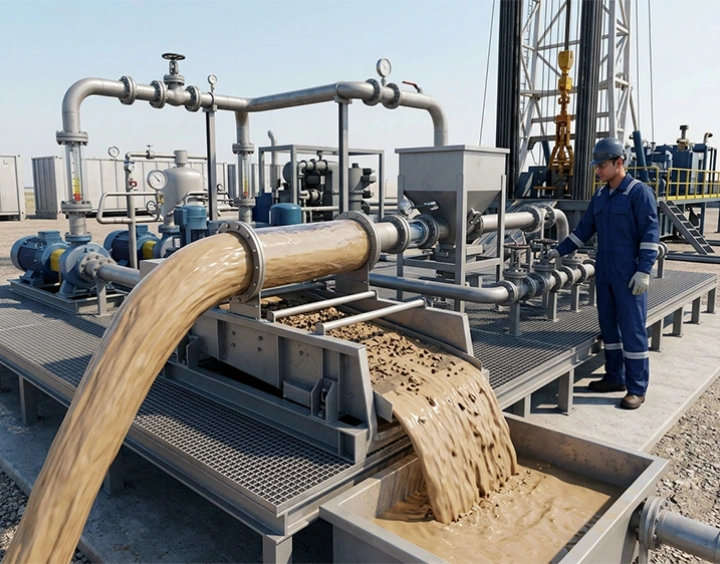
What Is Oil Drilling Fluid?
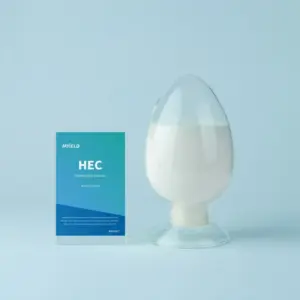
Drilling fluids and related oilfield fluid systems are used to transport cuttings, cool and lubricate equipment, stabilize the wellbore, and maintain efficient circulation during operations. In many water-based systems, cellulose polymers are used to control viscosity and flow behavior, improve suspension stability, and support more consistent fluid performance. Myield’s non-ionic HEC grades provide reliable thickening and rheology control with good handling characteristics for practical fluid formulation.
Common Challenges in Water-Based Oilfield Fluids
Typical problems fluid engineers aim to control include:
Insufficient cuttings carrying capacity — poor hole cleaning and higher risk of settling
Unstable viscosity across temperature/salinity changes — unpredictable circulation and pumping behavior (system-dependent)
Poor suspension stability in static periods — barite/cuttings sag and settling risk (system-dependent)
High fluid loss / filtration concerns — reduced operational efficiency (system-dependent)
Slow hydration or lumping — difficult mixing and batch variability
Over-thickening or shear sensitivity — higher pump pressure and reduced controllability (system-dependent)
Myield Chemical Solution
Cellulose Ethers (HEC) — viscosity building, rheology control, and suspension support for water-based oilfield fluids (trial-based).
Cellulose in Oilfield Drilling
In oilfield drilling applications, cellulose ether (HEC) is widely used in water-based fluid systems where viscosity and suspension control are required. Proper grade selection helps balance cuttings transport, pumpability, and ease of mixing.
Key Benefits of HEC in Oilfield Drilling Fluids
Recommended Myield HEC Grades for Oil Drilling
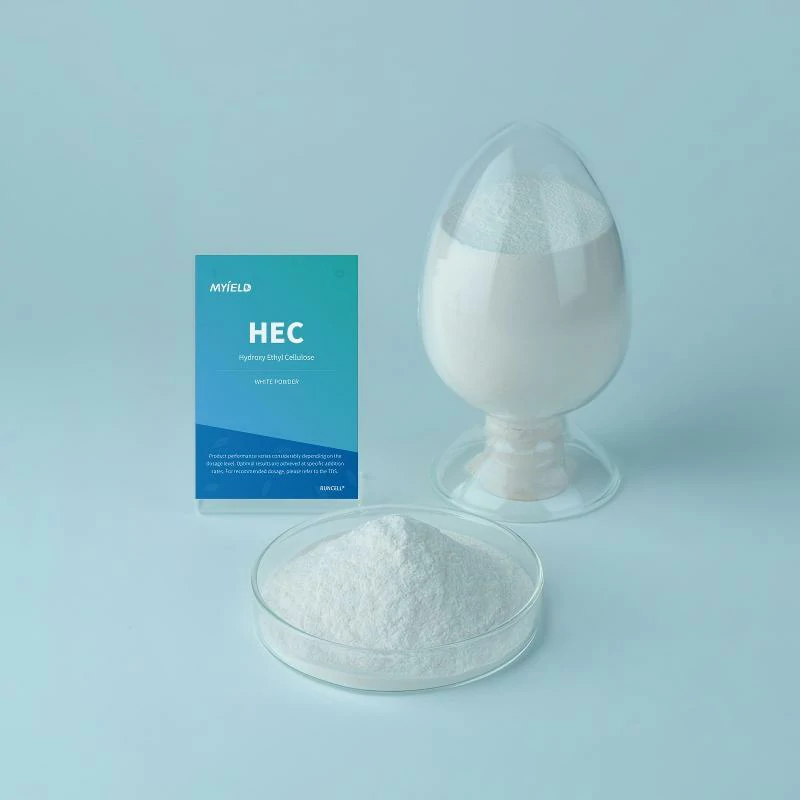
RUNCELL® HEC-100K
- Recommended for: Water-based drilling fluid systems needing balanced viscosity build and controllability
- Formulation value: Reliable thickening and rheology tuning direction (trial-based)
- Trial starting point: typically ~0.10%–0.40% by weight of water (BWOW), adjust to target PV/YP (trial-based)
RUNCELL® HEC-300
- Recommended for: Higher-viscosity sweep fluids or systems requiring stronger carrying capacity direction (system-dependent)
- Formulation value: Stronger viscosity build direction; supports hole-cleaning sweep design (trial-based)
- Trial starting point: typically ~0.15%–0.60% BWOW, optimize for pumpability and ECD constraints
RUNCELL® HEC-2000
- Recommended for: Systems requiring high viscosity build and stronger suspension direction (system-dependent)
- Formulation value: High thickening efficiency direction in selected water-based fluids (trial-based)
- Trial starting point: typically ~0.15%–0.70% BWOW, verify mixing sequence to avoid over-thickening
RUNCELL® HEC-6000
- Recommended for: Specialty high-viscosity sweeps or gel-type fluids where very high build is required (system-dependent)
- Formulation value: Maximum viscosity build direction (trial-based)
- Trial starting point: typically ~0.10%–0.50% BWOW; start low and titrate to target rheology
Why Choose Myield Chemical
FAQ
Yes. HEC is commonly used in water-based oilfield fluid systems as a rheology modifier and viscosity builder. Grade and dosage depend on base water, salinity, temperature, and target rheology.
Use controlled addition under sufficient mixing. Optimize mixing sequence by trials based on your equipment and base water.
Higher-viscosity grades such as HEC-300, HEC-2000, or HEC-6000 can be considered for sweep designs. Confirm pumpability, ECD, and hydration behavior by trials.