




























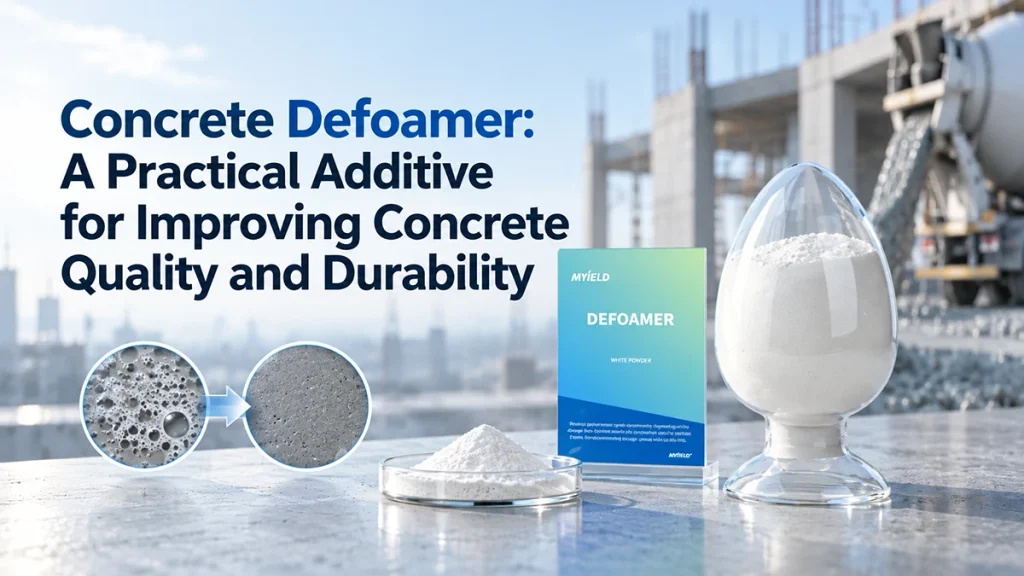
In concrete production and construction, air bubbles can easily be introduced during mixing, pumping, vibration, pouring, and transportation. While a controlled amount of entrained air may be useful in some concrete systems, excessive or unwanted air can negatively affect concrete density, strength, surface appearance, and durability.
This is where a suitable concrete defoamer can play an important role. By helping reduce unwanted foam and air bubbles in the concrete system, defoamers can contribute to more stable processing and better final performance.
Why Are Excessive Air Bubbles a Problem in Concrete?
During concrete preparation, mechanical mixing and material interactions may introduce air into the system. If too many bubbles remain trapped in the concrete, they can form pores and voids after hardening.
These voids may lead to several problems, including:
- Reduced concrete density
- Lower compressive strength
- Poorer surface appearance
- Increased permeability
- Lower resistance to water penetration
- Possible reduction in long-term durability
For applications where concrete quality and structural performance are important, controlling unnecessary air content becomes an important part of formulation and production.
How Does a Concrete Defoamer Work?
A concrete defoamer is designed to control and reduce unwanted foam and air bubbles within the system.
During mixing, it can help destabilize foam films and promote the release of trapped air. This allows bubbles to collapse more easily before the concrete hardens.
With proper dosage and compatibility, a defoamer can help improve the compactness and uniformity of the concrete structure.
However, the performance of a defoamer depends on many factors, including cement type, admixture system, water-to-cement ratio, mixing conditions, temperature, and other additives used in the formulation.
For this reason, laboratory testing and formulation adjustment are always recommended before large-scale application.
Benefits of Using Defoamer in Concrete
A suitable defoamer can provide several potential benefits in concrete and cement-based formulations.
1. Reduce Unwanted Air Content
One of the main functions of a defoamer is to reduce excessive air bubbles generated during mixing and processing.
Lower unwanted air content can help improve the compactness of the hardened concrete.
2. Improve Concrete Density
When excessive pores and voids are reduced, the concrete structure can become denser and more uniform.
This can contribute to better mechanical performance and durability.
3. Support Higher Strength Performance
Excessive entrapped air may reduce compressive strength. By controlling unnecessary air bubbles, a suitable defoamer can help support a more compact cement matrix.
4. Improve Surface Quality
Air bubbles can sometimes lead to pinholes, pores, or other visible defects on concrete surfaces.
Using the right defoamer may help produce smoother and more consistent finished surfaces.
5. Improve Water Resistance and Durability
A more compact concrete structure generally contains fewer interconnected voids.
This can help reduce water penetration and support improved durability in demanding environments.
When Is Concrete Defoamer Particularly Useful?
Concrete defoamers may be considered in applications where mixing, pumping, vibration, or other processing steps generate excessive air.
They can also be useful in concrete systems that require good density, low porosity, and consistent appearance.
Typical applications may include:
- Ready-mix concrete
- Precast concrete
- Self-leveling cement systems
- Dry-mix mortar
- Cement-based repair materials
- High-performance concrete
- Industrial flooring systems
- Infrastructure projects such as roads, bridges, dams, and airport facilities
Different formulations may require different defoamer types and dosage levels, so product selection should always be based on the actual application system.
Choosing the Right Defoamer Is Important
Not every defoamer performs the same way in every formulation.
An effective product should provide good foam-control performance while maintaining compatibility with cement, superplasticizers, polymers, and other additives.
Excessive dosage may also affect the overall formulation, so it is important to determine the proper addition level through testing.
For manufacturers and formulators, the ideal approach is to evaluate:
- Defoaming efficiency
- Compatibility
- Dosage
- Effect on workability
- Effect on strength
- Effect on surface quality
- Long-term stability
This helps ensure that the defoamer improves the system without creating new formulation problems.
Myield Chemical: Reliable Construction Additive Solutions
Henan Mingya Chemical Technology Co., Ltd. supplies construction chemical additives for concrete, dry-mix mortar, and other cement-based applications. We focus on providing stable products, practical application support, and suitable solutions for customers with different formulation requirements.
If you are looking for a concrete defoamer supplier, need help selecting a suitable grade, or would like to request product specifications, samples, or a quotation, please contact us:
Henan Mingya Chemical Technology Co., Ltd.
Email: [email protected]
WhatsApp: +86-18538509097