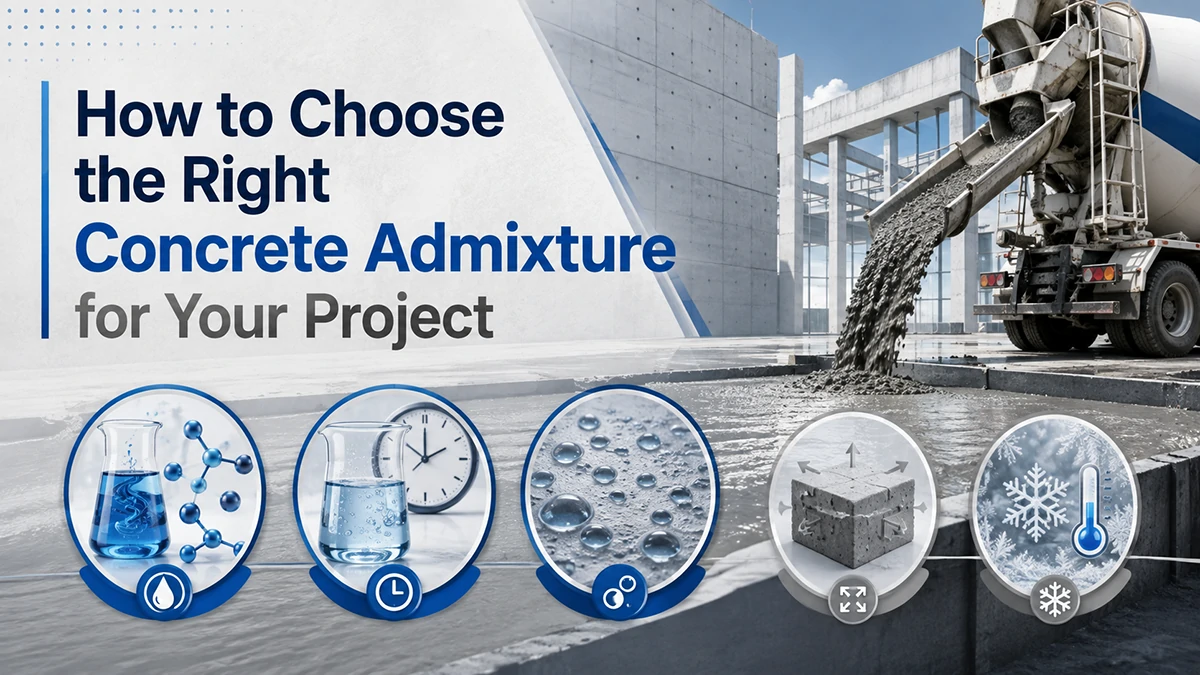



















Air entraining agents play an important role in modern concrete production by improving workability, reducing bleeding, and enhancing resistance to freeze-thaw damage. From highways and dams to high-performance concrete structures, the proper use of air entraining admixtures can significantly improve construction efficiency and long-term durability.
However, different air entraining agents have different concentrations, physical forms, and application characteristics. Understanding these differences helps concrete manufacturers select suitable products for their formulations.
What Is an Air Entraining Agent and How Does It Work?
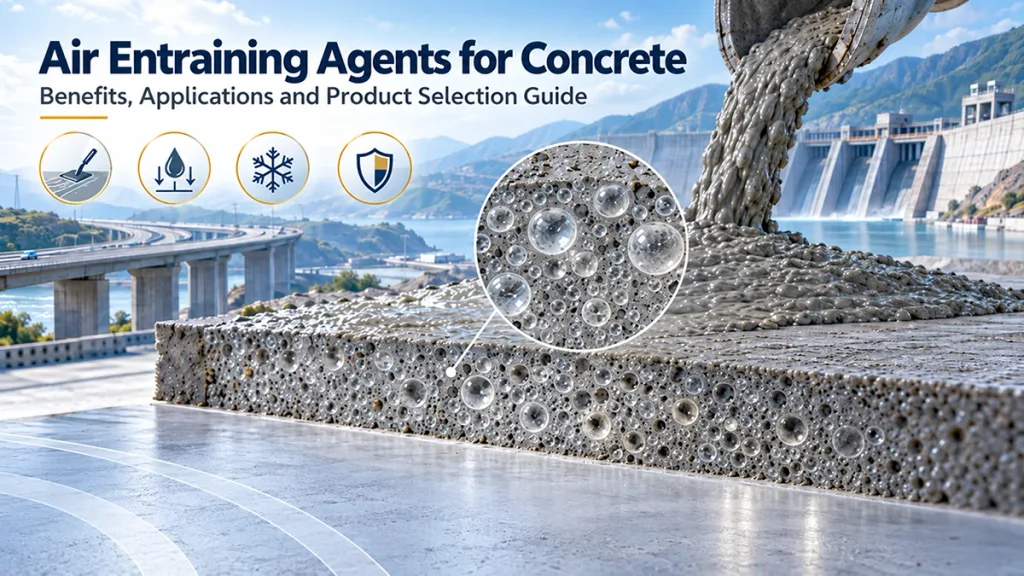
An Air Entraining Agent (AEA) is a chemical admixture that introduces numerous small, stable air bubbles into fresh concrete during mixing.
These bubbles are distributed throughout the cement paste, creating microscopic spaces that help relieve internal pressure when water freezes and expands.
Air entraining agents typically work by reducing the surface tension of water and stabilizing air bubbles through surfactant activity.
Unlike irregular entrapped air, properly entrained microscopic bubbles form a more controlled air-void system that can improve concrete performance.
Key Benefits of Air Entraining Agents in Concrete
1. Enhanced Freeze-Thaw Resistance
Microscopic air bubbles provide space for expanding water during freezing, helping reduce cracking and surface scaling caused by repeated freeze-thaw cycles.
2. Improved Concrete Workability
Entrained air can improve mixture cohesion and ease of placement, particularly in concrete with relatively low workability.
3. Reduced Bleeding and Segregation
A suitable air-void system can improve concrete stability, helping reduce water separation and aggregate segregation.
4. Improved Durability
With proper air content and mix design, air entrainment can contribute to better resistance against freezing conditions and deicing-related surface damage.
Four MYIELD Air Entraining Agent Products
MYIELD Chemical offers four anionic surfactant-based grades with different active contents and physical forms.
| Product | Form | Active Principle Content | Product Characteristics |
| AE-05 | Powder | 45–50% | Economical surfactant with good foaming properties |
| AE-10 | Powder | 90–95% | Higher-concentration surfactant with strong foaming ability |
| AE-100L | Liquid | 36 ± 1% | Foam stabilization and bleeding-control characteristics |
| AE-200L | Liquid | 28 ± 1% | Microbubble formation for concrete durability applications |
Powder Air Entraining Agents: AE-05 and AE-10
AE-05 and AE-10 are water-soluble anionic surfactants with excellent foaming, emulsifying, and hard-water resistance properties.
AE-05 offers an economical formulation with 45–50% active principle content, while AE-10 provides a higher concentration of 90–95%.
Both grades list construction air entrainment among their applications, making them candidates for formulation evaluation where powder additives are preferred.
Liquid Air Entraining Agents: AE-100L and AE-200L
AE-100L and AE-200L are liquid anionic surfactants designed to promote microbubble formation in cementitious materials.
AE-100L features foam-stabilizing characteristics and is described as suitable for improving concrete bleeding behavior.
AE-200L provides similar air-entraining functionality with a different active principle concentration.
Both grades are intended for concrete applications requiring improved workability and durability, particularly where freeze resistance, impermeability, and sulfate corrosion resistance are important.
Their different concentrations should not be interpreted as a direct ranking of performance. Actual results require concrete mix testing.
Main Applications of Air Entraining Agents
Air entraining agents are commonly used in concrete exposed to demanding environmental and construction conditions.
Highways and Pavements: Improve resistance to freeze-thaw damage and deicing-related surface deterioration.
Dams and Hydraulic Structures: Support concrete durability in structures exposed to water and changing temperatures.
Ports and Marine Infrastructure: Contribute to appropriate concrete durability strategies in challenging exposure environments.
High-Performance Concrete: Help improve mixture cohesion and achieve controlled air entrainment when required.
Precast Concrete: Support workability and durability requirements in suitable precast formulations.
How to Choose the Right Air Entraining Agent
Selecting an air entraining agent requires evaluating the application, target air content, product concentration, and compatibility with cement and other admixtures.
Powder grades may be convenient for manufacturers using dry additive systems, while liquid grades offer practical dosing options for concrete batching operations.
Air content must be carefully controlled. Excessive air entrainment can reduce compressive strength, while insufficient or poorly distributed air voids may fail to provide adequate freeze-thaw protection.
Laboratory trials should evaluate air content, bubble stability, workability, strength, and performance under actual production conditions.
Looking for the Right Air Entraining Agent for Your Concrete?
Struggling with excessive bleeding, unstable air content, poor workability, or insufficient freeze-thaw resistance?
The right air entraining agent could make a significant difference in your concrete formulation.
At MYIELD Chemical, we offer AE-05, AE-10, AE-100L, and AE-200L to support different formulation and application requirements.
Tell us your concrete application, target air content, cement type, and preferred product form. Our team can help you identify a suitable grade for evaluation and provide technical data sheets and sample support.
Contact MYIELD Chemical Today
Email: [email protected]
WhatsApp: +86 18538509097
Share your concrete formulation challenges with us and discover a suitable air entraining solution for your next project.