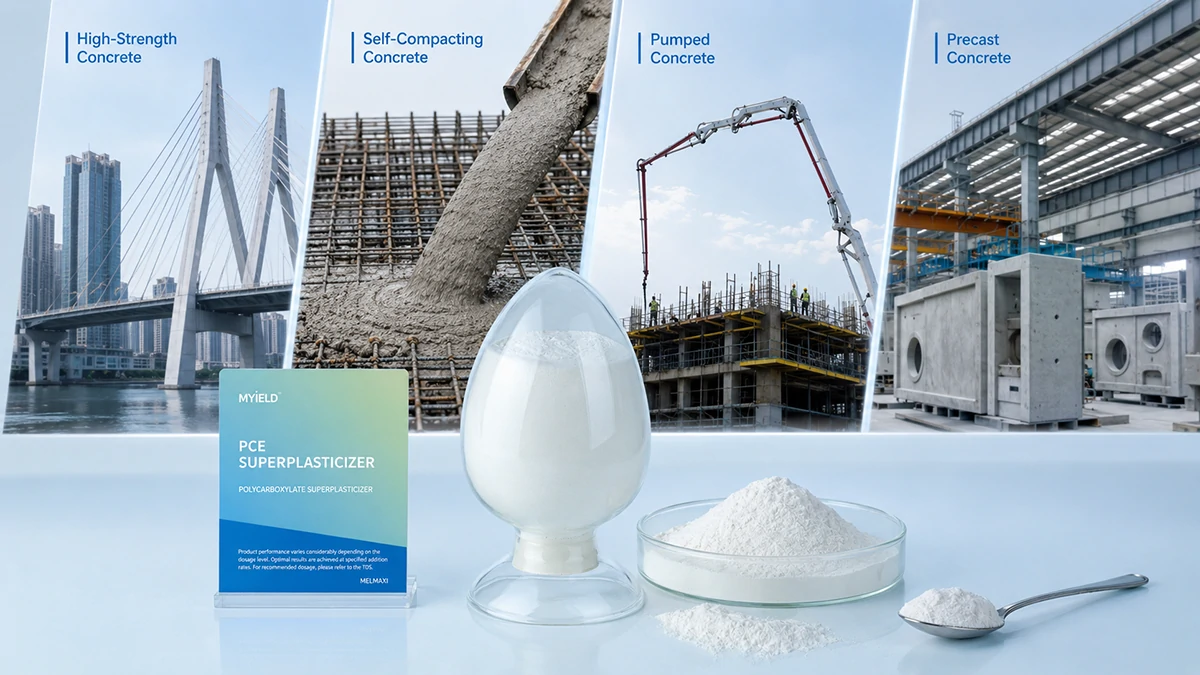
































Modern cementitious materials increasingly require a balance between high fluidity, reduced water demand, strength development, and stable processing performance. Sulfonated Melamine Formaldehyde Superplasticizer, commonly known as SMF Superplasticizer, remains an important high-range water-reducing admixture for many concrete, mortar, and gypsum-based applications.
SMF is especially suitable for formulations where good dispersion, low air entrainment, low chloride content, and reliable compatibility with cementitious binders are required. For manufacturers of dry-mix mortar, self-leveling compounds, repair mortars, precast materials, and high-performance concrete, selecting the right SMF grade can significantly improve formulation efficiency and final product performance.
What Is Sulfonated Melamine Formaldehyde Superplasticizer?
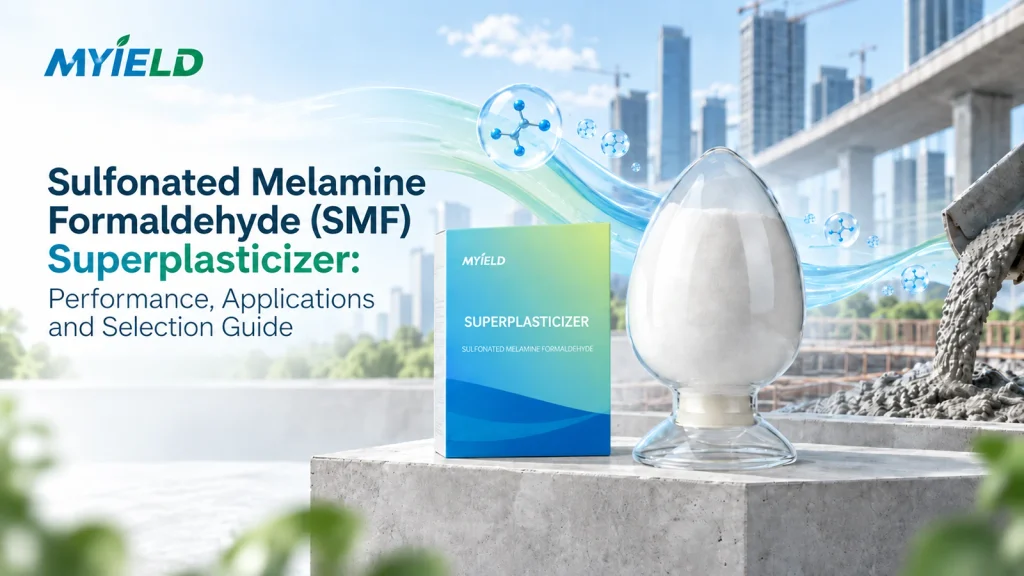
SMF Superplasticizer is a powder-form superplasticizer based on sulfonated melamine formaldehyde resin.
Its main function is to improve the dispersion of cement particles within a cementitious system. Better particle dispersion allows the formulation to achieve improved flowability while reducing the amount of mixing water required.
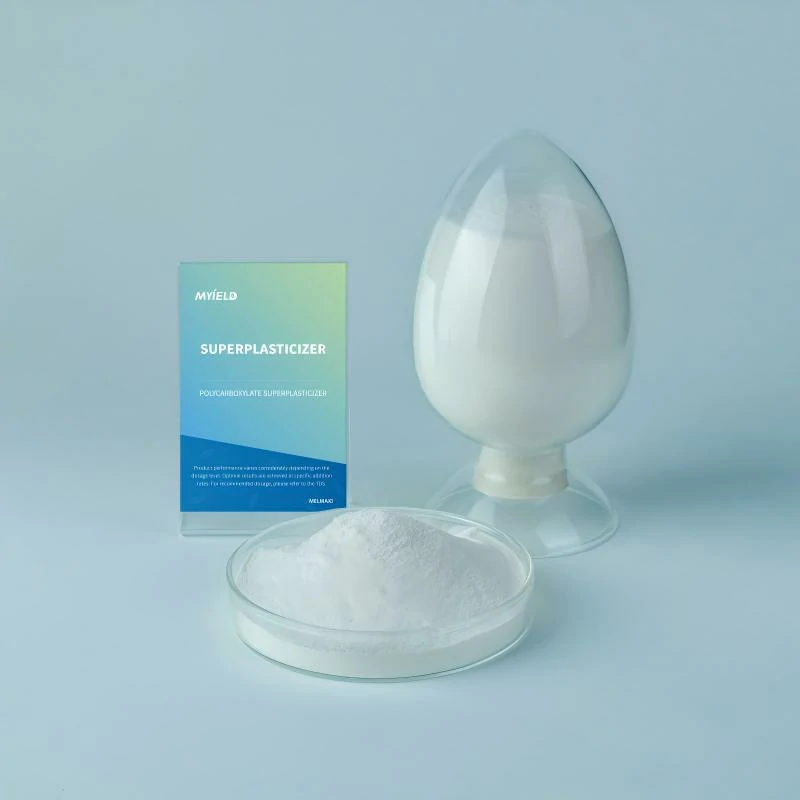
MYIELD’s MELMAXI™ SMF Superplasticizer is a white powder designed for cement and calcium sulphate-based materials. According to its technical data sheet, the product offers high water-reducing ability, low air entrainment, low chloride ion content, and good compatibility with different cement types. It can also help improve early strength, impermeability, workability, water retention, and adaptability to steam curing.
How Does SMF Improve Cementitious Materials?
In cement-based systems, achieving higher fluidity simply by adding more water can create several problems. Excessive water may negatively affect strength development, dimensional stability, and the overall density of the hardened material.
SMF provides another approach.
By improving the dispersion of cement particles, it helps release water trapped between agglomerated particles. As a result, the mixture can achieve better workability without relying solely on additional mixing water.
This makes SMF particularly useful in formulations requiring:
- High fluidity
- Reduced water demand
- Improved workability
- Low air entrainment
- Good early strength development
- Improved impermeability
- Stable performance in cementitious systems
For dry-mix manufacturers, this also provides more flexibility when designing formulations that need both processing performance and mechanical properties.
Key Technical Properties of MELMAXI™ SMF Superplasticizer
When selecting an SMF Superplasticizer, technical parameters such as chloride content, pH, bulk density, water-reducing performance, and recommended dosage should be considered carefully.
The main specifications of MYIELD MELMAXI™ SMF Superplasticizer are:
| Property | Specification |
| Appearance | White powder |
| Dry loss | Max. 5.0% |
| pH value | 7.0–9.0 |
| Bulk density | 400–700 g/L |
| SO₄²⁻ ion content | 3.0–4.0% |
| Cl⁻ ion content | Max. 0.05% |
| Air content of concrete test | Max. 3.0% |
| Water reducing ratio in concrete test | Min. 14.0% |
| Reference dosage | 0.3%–1.2% |
These specifications are taken directly from the current MYIELD TDS.
The relatively low chloride ion content is especially important for applications where formulators want to control the introduction of chloride-containing components into cementitious materials.
Main Applications of SMF Superplasticizer
One advantage of SMF is that it can be used across a wide range of cementitious and calcium sulphate-based formulations.
1. Tile Adhesives and Joint Fillers
Tile adhesive formulations require suitable consistency, workable open processing characteristics, and reliable application performance.
SMF can contribute to improved dispersion and fluidity while reducing unnecessary water demand in the formulation.
It can also be used in joint fillers where controlled consistency and good workability are important.
2. Self-Leveling Floor Screeds and Underlayments
Self-leveling products need excellent flowability to spread across the substrate and form a smooth surface.
SMF can help improve the fluidity of cement or calcium sulphate-based self-leveling formulations while maintaining a relatively low water-to-binder ratio.
This makes it useful in:
- Self-leveling cement
- Floor screeds
- Floor underlayments
- Calcium sulphate-based leveling materials
3. Repair and Injection Mortars
Repair mortars often require good flow and effective placement, especially when filling cracks, cavities, or confined areas.
Injection mortars also depend heavily on suitable rheological behavior.
By improving particle dispersion, SMF can help manufacturers achieve a more workable mortar system without excessive water addition.
4. Molding and Industrial Plaster
SMF is also suitable for molding materials and industrial plaster systems.
Because the product is optimized for both cement and calcium sulphate-based mixtures, it can be considered in gypsum-related formulations where improved fluidity and reduced water demand are desired.
5. Dry-Mix and High-Performance Concrete
MYIELD also recommends SMF for:
- Dry-mixed concrete
- High-performance concrete
- High-flowability concrete
Its combination of water-reducing performance, low air entrainment, and cement compatibility makes it suitable for a variety of concrete formulations.
SMF vs. Other Types of Superplasticizers
There are several major categories of concrete superplasticizers available in the market, including:
SNF Superplasticizer
Sulfonated Naphthalene Formaldehyde is widely used in concrete and mortar systems and has a long history in the construction admixture industry.
SMF Superplasticizer
Sulfonated Melamine Formaldehyde is particularly suitable for applications requiring strong dispersion, low air entrainment, good early strength development, and low chloride content.
PCE Superplasticizer
Polycarboxylate Ether represents a newer generation of high-range water-reducing technology and is widely used in modern high-performance concrete and advanced dry-mix systems.
There is no single superplasticizer that is automatically the best choice for every formulation.
The selection should depend on the binder system, required water reduction, flowability, strength requirements, compatibility, production process, and cost target.
How to Choose the Right SMF Superplasticizer
Before purchasing SMF, buyers should evaluate more than price alone.
Several factors should be considered:
Water-reducing performance: A suitable product should provide consistent water reduction under the intended formulation conditions.
Compatibility: Performance can vary depending on cement type, gypsum source, fillers, polymers, and other additives.
Chloride content: For many construction materials, low chloride content is an important technical consideration.
Dosage: The optimum dosage should be determined through formulation testing rather than relying only on a fixed theoretical value.
Batch consistency: For industrial-scale production, stable quality from batch to batch is essential to avoid changes in formulation performance.
For MELMAXI™ SMF, the recommended reference dosage range is 0.3%–1.2%, although the final dosage should be confirmed through actual formulation trials.
Packaging and Storage
MELMAXI™ SMF Superplasticizer is supplied in 25 kg net paper bags with PE inner liners, while customized packaging can also be discussed according to customer requirements.
The product should be stored in a dry and cool place at temperatures below 25°C. Packaging should remain properly sealed to prevent moisture ingress, as exposure to humidity may increase the water content of the powder.
Looking for an SMF Superplasticizer for Your Formulation?
The performance of an SMF Superplasticizer depends not only on the product itself, but also on the cement, gypsum, aggregates, polymers, and other additives used in the final formulation.
MYIELD MELMAXI™ SMF Superplasticizer is designed for cementitious mortars, calcium sulphate-based materials, self-leveling systems, repair mortars, tile adhesives, and concrete applications.
If you are developing a new formulation, replacing your current SMF supplier, or comparing SMF, SNF and PCE Superplasticizers, send us your application, required performance, current dosage, and formulation conditions.
Our team can help you identify a more suitable solution and provide the corresponding technical information.
Contact MYIELD Chemical
Whatsapp:+86-18538509097
Email: [email protected]