















In the production of cement-based building materials, excessive foam and entrapped air can create more problems than manufacturers expect. From self-leveling compounds and grouting materials to waterproof mortar and precast concrete components, unwanted bubbles may affect slurry density, surface appearance, and overall product consistency.
For manufacturers, the challenge is not simply eliminating foam. It is finding a defoamer that provides effective foam control without compromising slurry fluidity, compatibility, or the final surface quality.
This article explores how different powder defoamers can address common production challenges in cement-based building materials.
The Challenge: Excessive Foam and Poor Surface Quality
A manufacturer producing self-leveling mortar, cement-based grout, and waterproof mortar may encounter several recurring problems during production and application.
1. Excessive Entrapped Air
Mechanical mixing and chemical interactions between formulation components can introduce unwanted air into cementitious systems. Excessive bubbles may reduce slurry density and affect the uniformity of the finished material.
2. Pinholes and Surface Defects
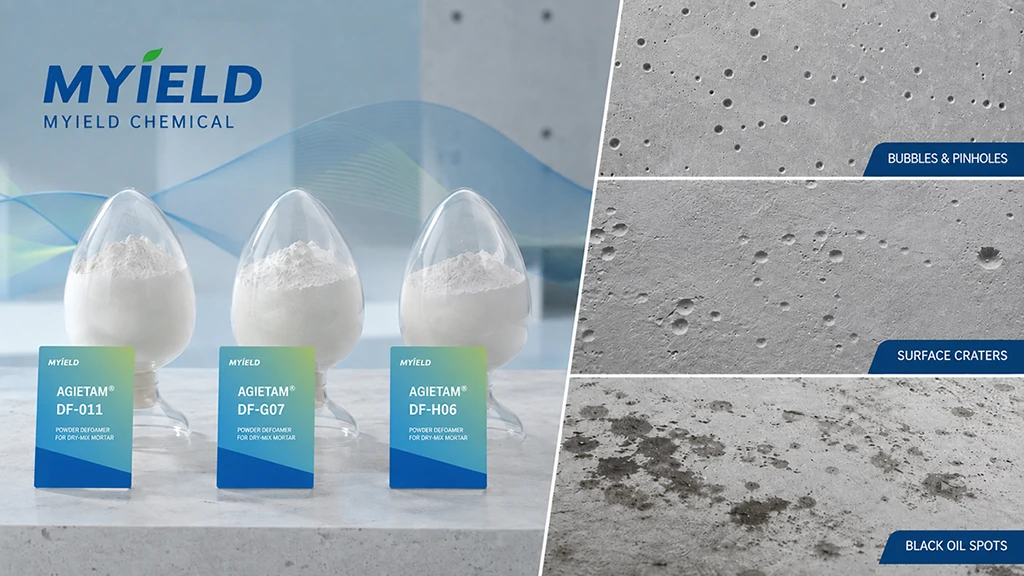
When entrapped air remains in the slurry, bubbles may rise and break during application, leaving pinholes, small craters, or uneven surfaces. These defects are particularly noticeable in self-leveling compounds and grouting applications, where a smooth finish is important.
3. Floating Oil and Black Oil Spots
Some formulations may experience floating oil or visible dark spots on the slurry surface. These issues can negatively affect the appearance of finished cement-based products.
4. Inconsistent Defoaming Performance
Different cement types, fillers, additives, mixing conditions, and ambient temperatures can influence foam formation and stability. A defoamer that works well in one formulation may not deliver the same results in another.
Therefore, manufacturers need to select defoamers according to their specific formulations and application requirements.
The Solution: Selecting the Right Powder Defoamer
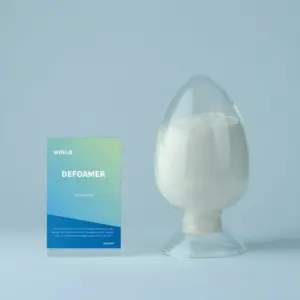
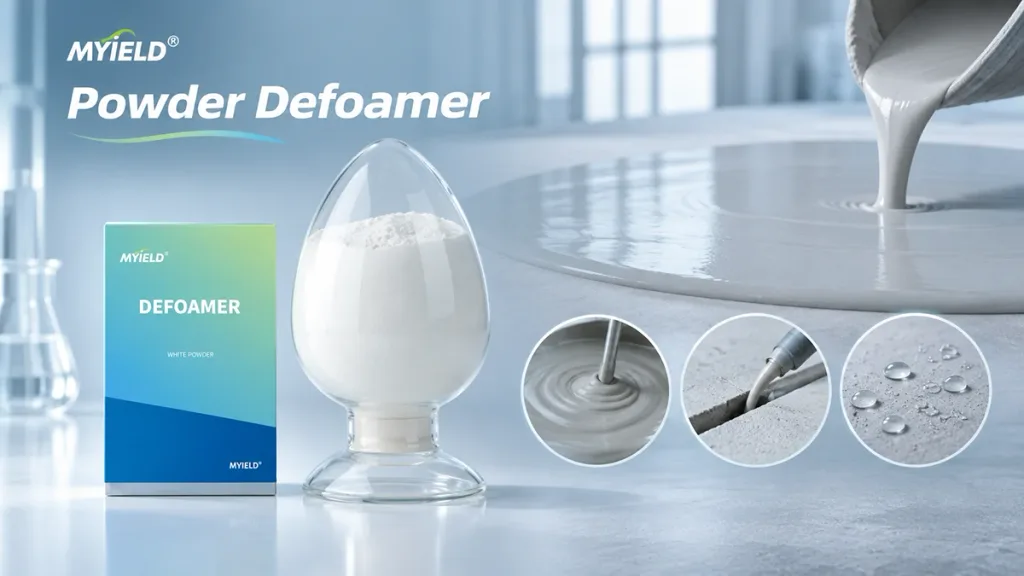
To address these challenges, Myield Chemical offers three powder defoamer grades: AGIETAM® DF-011, DF-G07, and DF-H06. Each grade has different application characteristics.
1. AGIETAM® DF-011 – Rapid and Long-Lasting Foam Control
DF-011 is a non-ionic polyether surfactant compound in powder form. It provides rapid defoaming and long-term foam control.
Its key advantages include:
- Rapid and sustained defoaming performance.
- Wetting properties that help improve slurry fluidity and workability.
- Reduced surface oil floating and fewer surface defects.
- Effective performance at relatively low addition levels.
- Good powder flowability and dispersion during production, with low dust generation.
DF-011 is suitable for cement-based dry mortars, including self-leveling compounds, grouting materials, repair mortars, and UHPC. It can also be used in concrete and cement product components such as grindstones, wallboards, and artificial stone.
2. DF-G07 – Defoaming Performance in Low-Temperature Conditions
DF-G07 is a highly effective powder defoamer designed for neutral and alkaline building material systems.
It is particularly suitable for applications requiring reliable foam control under low-temperature conditions.
Its main advantages include:
- Effective foam reduction.
- Improved slurry density.
- Reduced floating oil on the slurry surface.
- Good compatibility with most building material additives.
Typical applications include self-leveling cement, grouting materials, waterproof mortar, caulking agents, putty, decorative mortar, and gypsum prefabricated boards.
For manufacturers operating in colder environments, DF-G07 is a grade worth evaluating.
3. DF-H06 – Fast Defoaming for Surface-Sensitive Applications
DF-H06 is a mixture of polyether surfactant and a dry powder carrier.
It is designed to quickly remove bubbles introduced through mechanical mixing or chemical reactions and help eliminate black oil spots on the slurry surface.
According to its technical data sheet, defoaming can generally be completed within 40–90 seconds after mortar mixing is completed.
DF-H06 is particularly suitable for applications where surface appearance is important, including:
- Cement-based self-leveling compounds.
- Grouting materials.
- Caulking agents.
- Bonding and waterproof mortars.
- Cement and gypsum prefabricated components.
For manufacturers concerned about pinholes, black oil spots, and surface imperfections, DF-H06 is a suitable option for formulation trials.
Recommended Dosage and Application
The recommended dosage varies depending on the product and formulation:
| Product | Recommended Dosage |
|---|---|
| DF-011 | 0.05%–0.2% of total dry mortar weight |
| DF-G07 | 0.1%–0.2% of total mortar weight |
| DF-H06 | 0.1%–0.2% of the system; 0.1%–0.3% may be used for common defoaming requirements |
DF-011 can be blended with other solid components in the formulation. DF-G07 should be thoroughly mixed with dry mortar before adding water.
For DF-H06, the dosage can be adjusted according to surface quality requirements.
These figures are starting recommendations rather than universal formulations. Actual dosage should be established through laboratory testing using the customer’s cement, fillers, aggregates, and other additives.
How to Achieve Better Results
Choosing the right defoamer is only part of the solution. Manufacturers should also evaluate the complete formulation and mixing process.
We recommend checking the following during laboratory trials:
- Foam formation immediately after mixing.
- Slurry density and fluidity.
- Surface pinholes and visible oil spots.
- Bleeding and segregation.
- Compatibility with other admixtures.
- Surface appearance after application and hardening.
A systematic comparison of different grades and dosage levels helps identify the most suitable solution for each application.
Conclusion: The Right Defoamer Makes a Difference
Foam control is an important part of producing consistent, high-quality cement-based building materials.
Whether the priority is rapid and sustained defoaming, better performance in low-temperature conditions, or improved surface appearance, selecting the appropriate powder defoamer can help manufacturers address their specific production challenges.
Myield Chemical provides DF-011, DF-G07, and DF-H06 powder defoamers for different cementitious and building material applications.
Looking for the Right Defoamer for Your Application?
Whether you are experiencing excessive foam, surface pinholes, floating oil, or inconsistent slurry performance, Myield Chemical is ready to help you find a suitable solution.
Contact our team to discuss your formulation requirements and explore the right powder defoamer for your application.
Email: [email protected]
WhatsApp: +86 18538509097
Share your concrete or mortar formulation challenges with us, and let Myield Chemical support your next project with the right defoaming solution.
Myield Chemical – Better Additives, Better Lives.