

































In dry-mix mortars, tile adhesives, repair mortars, and other cement-based construction materials, construction efficiency and early strength are important factors in formulation design. This is especially true for low-temperature or winter construction, as well as projects that require fast demolding or quick progression to the next construction stage.
As a commonly used early-strength accelerator and setting accelerator for cement-based materials, calcium formate has attracted increasing attention in the construction industry. But how exactly does calcium formate accelerate cement hydration and improve the early strength of mortar and concrete?
1. What Is Calcium Formate?
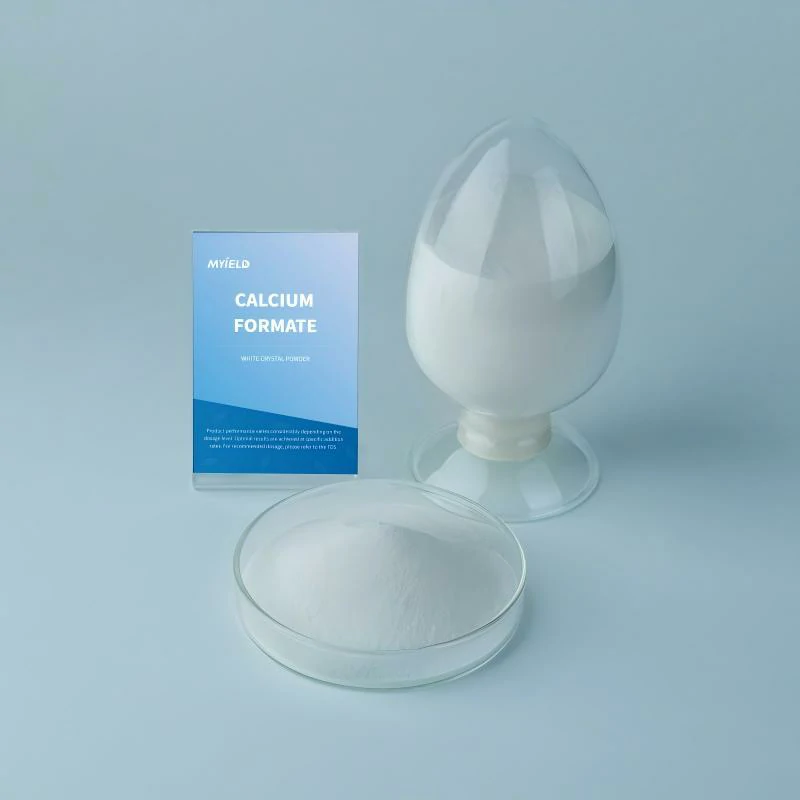
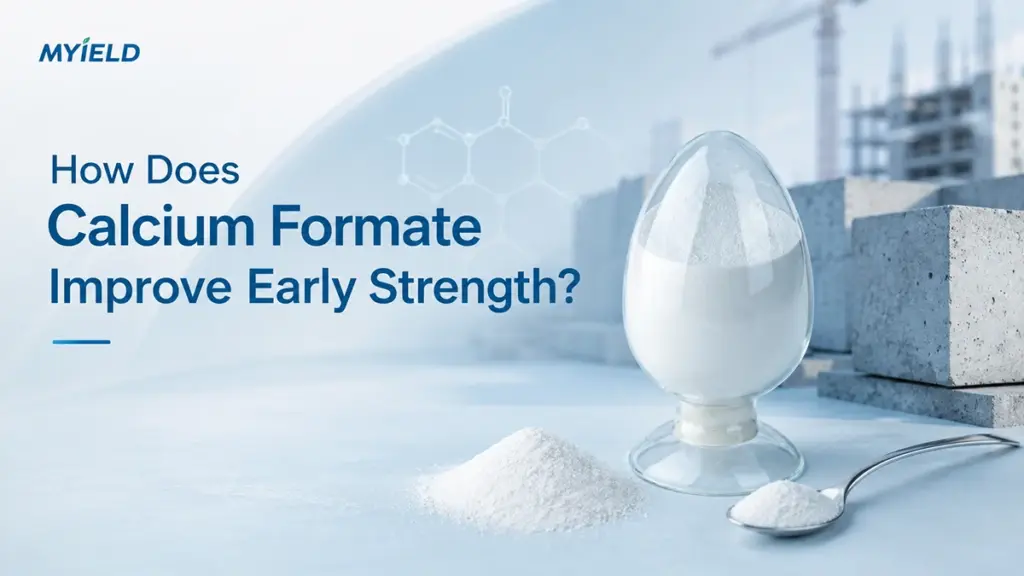
Calcium formate has the chemical formula Ca(HCOO)₂. It is typically supplied as a white or off-white crystalline powder with good water solubility.
In construction materials, industrial-grade calcium formate is mainly used in cement-based dry-mix mortar systems as a functional additive for improving early strength.
Compared with traditional chloride-based accelerators, calcium formate does not introduce chloride ions into the formulation. This makes it particularly suitable for cement-based systems where durability and the risk of steel reinforcement corrosion are important considerations.
2. How Does Calcium Formate Affect Cement Hydration?
When cement is mixed with water, it does not simply “dry” or “harden.” Instead, it undergoes a series of complex processes involving dissolution, chemical reactions, nucleation, and crystal growth.
Cement clinker minerals such as tricalcium silicate (C₃S), dicalcium silicate (C₂S), and aluminates gradually react with water to form hydration products, including calcium silicate hydrate (C-S-H) and calcium hydroxide.
As these hydration products continue to form and interconnect, they gradually develop a dense solid structure, transforming the cement paste from a workable state into a hardened material with mechanical strength.
When calcium formate is added to the cement system, it dissolves and releases Ca²⁺ ions and HCOO⁻ ions. These ions alter the ionic environment around the cement particles and influence the early-stage hydration process.
3. Accelerating Early Cement Hydration and Strength Development
The development of early strength is closely related to the rate of cement hydration.
After calcium formate dissolves, the additional calcium ions increase the Ca²⁺ concentration in the pore solution and can influence clinker dissolution, nucleation of hydration products, and crystal growth.
At an appropriate dosage, calcium formate can shorten the induction period in certain cement systems, allowing hydration to enter the acceleration stage sooner and promoting the formation of hydration products such as C-S-H gel.
As more hydration products form at an earlier stage, a continuous structural network develops more quickly between cement particles. This accelerates hardening and contributes to higher early strength.
This is one of the main reasons calcium formate is widely used as an early-strength additive in cement-based materials.
4. Promoting Early Microstructure Development
In addition to accelerating cement hydration, calcium formate can also influence the development of the early microstructure of cement paste.
As hydration proceeds more rapidly, additional hydration products are formed on the surfaces of cement particles and within the pore spaces between them.
The continued formation of C-S-H gel helps create stronger connections between cement particles, allowing the internal structure to develop more quickly.
Under properly designed formulation conditions, calcium formate can therefore help cement-based materials reach the required mechanical strength sooner, supporting faster construction progress.
However, higher dosage does not necessarily mean better performance. The actual effect of calcium formate depends on many factors, including cement type, ambient temperature, water-to-cement ratio, superplasticizers, cellulose ethers, redispersible polymer powders, and other additives.
For this reason, the optimum dosage should always be determined through formulation testing.
5. Greater Benefits Under Low-Temperature Conditions
Temperature has a significant influence on the rate of cement hydration.
When the ambient temperature decreases, cement hydration slows down, resulting in longer setting times and slower strength development. This effect becomes particularly noticeable during winter or low-temperature construction.
Because calcium formate promotes early cement hydration, it can be especially useful under such conditions.
When properly incorporated into tile adhesives, plastering mortars, repair mortars, and other cement-based dry-mix mortars, calcium formate can help accelerate early strength development, improve construction efficiency, and reduce the negative impact of low temperatures on cement hydration.
6. Main Applications of Calcium Formate in Construction Materials
Thanks to its ability to accelerate early hydration, improve early strength, and support better performance under low-temperature conditions, calcium formate has become a widely used functional additive in dry-mix mortar formulations.
Typical applications include:
- Tile adhesives
- Cement-based repair mortars
- Plastering mortars
- Masonry mortars
- Self-leveling compounds
- Grouting materials
- Rapid-hardening cement products
- Cement-based materials for winter construction
- Other dry-mix mortars requiring faster setting and early strength development
Different mortar systems have different requirements for setting time, open time, workability, and early strength. Therefore, the dosage of calcium formate should be adjusted according to the cement system and the combination of other chemical additives.
7. Why Product Consistency Matters
For dry-mix mortar manufacturers, calcium formate should not only provide reliable early-strength performance. Product stability, batch-to-batch consistency, and compatibility with other additives are equally important.
Variations in raw material quality may directly affect mortar setting time, workability, and early strength. For industrial production, it is therefore important to select a stable and reliable calcium formate supplier and determine the appropriate dosage through laboratory testing.
Myield Chemical supplies industrial-grade calcium formate for tile adhesives, dry-mix mortars, cement-based repair materials, and other construction applications.
According to different cement systems and performance requirements, we can provide samples, technical data, and product selection support to help customers optimize setting time, early strength, and low-temperature performance.
For Calcium Formate samples, TDS, quotations, or application support, please contact us:
Myield Chemical
Email: [email protected]
WhatsApp: +86 185 3850 9097