

































As the construction industry moves toward sustainable development, reducing clinker content has become an important approach to lowering carbon emissions from cement production.
However, replacing clinker with supplementary cementitious materials (SCMs), such as fly ash and slag, can slow down cement hydration and reduce early strength.
How can cement manufacturers maintain sufficient early strength while reducing clinker content?
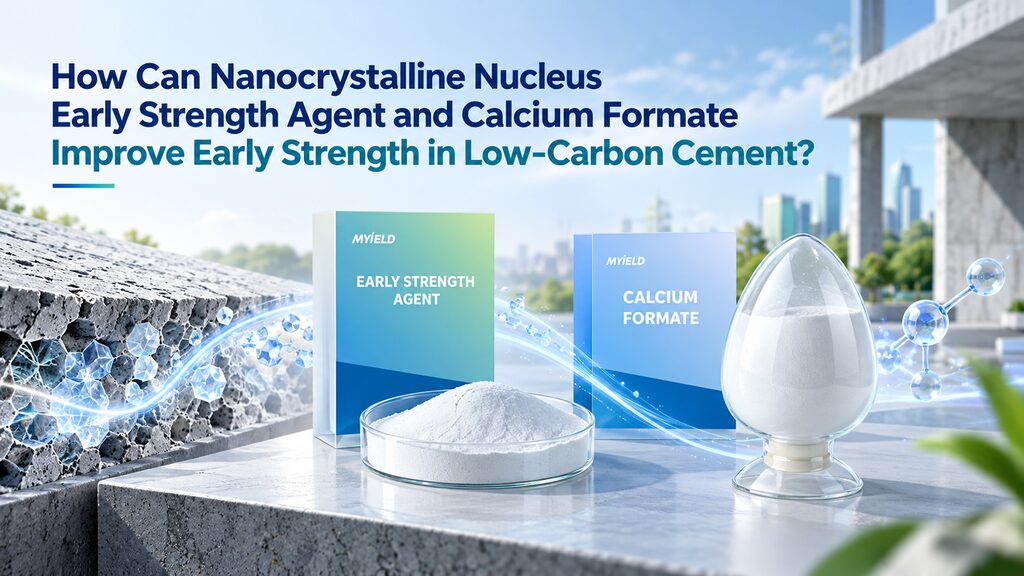
Two promising solutions are Nanocrystalline Nucleus Early Strength Agent and Calcium Formate, which improve early cement hydration through different but potentially complementary mechanisms.
1. The Challenge: Reducing Clinker Without Sacrificing Early Strength
Clinker plays an essential role in cement hydration and early strength development.
When clinker content decreases, cement may experience slower hydration, delayed setting, and lower 1-day or 3-day compressive strength.
These challenges can affect construction efficiency, formwork removal, and precast concrete production.
Therefore, achieving low-carbon cement requires more than reducing clinker content. It also requires effective hydration control to maintain early-age performance.
Chemical additives offer a practical approach to balancing carbon reduction and early strength development.
2. Nanocrystalline Nucleus Early Strength Agent: Accelerating Hydration Through Nucleation
Nanocrystalline Nucleus Early Strength Agent, particularly C-S-H-based formulations, provides additional nucleation sites for cement hydration products.
These nanoparticles act like tiny seeds, encouraging calcium silicate hydrate (C-S-H) to form and grow more rapidly.
Its main benefits include:
- Providing additional nucleation sites for hydration products.
- Accelerating early C-S-H formation.
- Promoting early microstructure development.
- Supporting early strength development in low-clinker cement systems.
By accelerating hydration product formation, nanocrystalline nucleus technology can help compensate for slower early hydration caused by clinker replacement.
However, actual performance depends on cement composition, dosage, curing conditions, and compatibility with other admixtures.
3. Calcium Formate: Improving Early Strength Through Hydration Acceleration
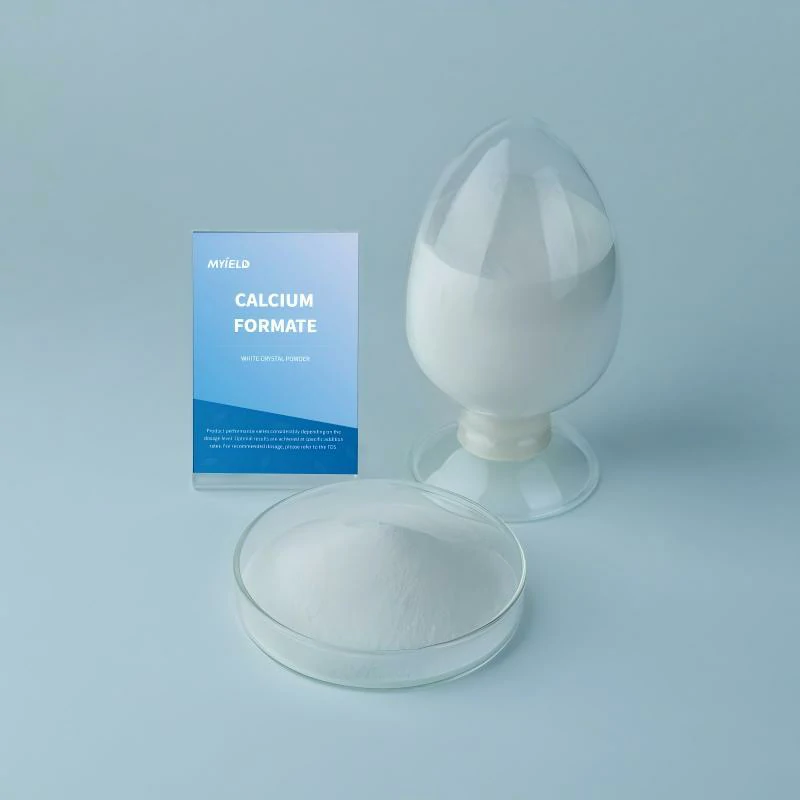
While nanocrystalline nucleus early strength agents promote hydration through nucleation, Calcium Formate (Ca(HCOO)₂) influences hydration kinetics to accelerate early cement reactions.
Calcium Formate is widely used as an early-strength accelerator in cement-based construction materials.
Its main advantages include:
- Accelerating early cement hydration.
- Improving early compressive strength.
- Supporting strength development under suitable low-temperature conditions.
- Helping improve construction efficiency and early demolding performance.
Calcium Formate is commonly used in dry-mix mortars, tile adhesives, repair mortars, and other cement-based applications.
Its effectiveness depends on dosage, cement chemistry, and curing conditions. Appropriate formulation testing is essential to achieve optimal performance.
4. Combining Both Additives: Two Complementary Approaches
Although these two additives work through different mechanisms, they may complement each other in suitable cementitious systems.
Nanocrystalline Nucleus Early Strength Agent → Provides nucleation sites and promotes C-S-H growth.
Calcium Formate → Accelerates hydration reactions and supports early strength development.
In simple terms, one helps hydration products form, while the other helps the hydration process proceed faster.
Their combined use may provide additional opportunities to improve early strength in low-carbon cement formulations.
However, the effectiveness of this combination should be verified through laboratory testing, considering setting time, workability, compressive strength, and formulation compatibility.
5. Myield Chemical: Supporting Low-Carbon Cement Development
At Henan Mingya Chemical Technology Co., Ltd. (Myield Chemical), we supply both Nanocrystalline Nucleus Early Strength Agent and Calcium Formate to help manufacturers optimize cement and mortar formulations.
Our solutions include:
Nanocrystalline Nucleus Early Strength Agent
Supports early C-S-H formation and hydration development, offering a promising solution for improving early strength in suitable cementitious systems.
An effective early-strength accelerator that helps promote cement hydration and improve early-age strength development.
These two products provide complementary technical options for cement manufacturers seeking better early performance, improved production efficiency, and more sustainable formulations.
6. Looking for an Effective Early-Strength Solution?
Is your low-carbon cement struggling to achieve the required 1-day or 3-day compressive strength?
The right early-strength additive—or a carefully optimized combination—could help improve your formulation.
At Myield Chemical, we are ready to discuss your cement composition, target strength, and application requirements to help identify suitable product options.
Contact us today to request product information, available samples, or a competitive quotation.
Henan Mingya Chemical Technology Co., Ltd.
Website: https://www.mingyachem.com
WhatsApp: +86 18538509097
Contact Us: https://www.mingyachem.com/contact-us
Tell us your current early-strength challenges and target performance. Let’s explore a more efficient solution for your cement formulation.