

































Concrete Admixtures: The Chemical Secret Behind High-Quality Concrete
In the world of concrete, chemical admixtures play an essential role in improving construction performance and ensuring structural quality. Even high-quality cement, sand, and aggregates may not achieve the desired engineering performance without suitable admixtures.
Today, let’s explore these important chemical additives and understand how they improve concrete performance.
1.Concrete Admixtures: Performance Enhancers for Modern Construction
Many people believe that concrete is simply a mixture of cement, sand, aggregates, and water. However, modern concrete technology is much more complex.
Concrete admixtures are like seasonings in cooking. Although they are used in relatively small amounts, they can significantly influence the properties and performance of concrete.
They mainly address three important aspects:
Improving Workability: Concrete admixtures enhance flowability and consistency, making concrete easier to pump, pour, and distribute evenly during construction.
Controlling Setting Time: Under hot weather conditions, certain admixtures can delay setting to provide sufficient working time. In cold weather or time-sensitive projects, other admixtures can accelerate setting or early strength development.
Enhancing Durability: Properly selected admixtures can improve concrete density, reduce water permeability, enhance freeze-thaw resistance, and extend the service life of concrete structures.
2.Common Types of Concrete Admixtures and Their Functions

2.1 Water-Reducing Admixtures: The Key to Better Concrete Performance
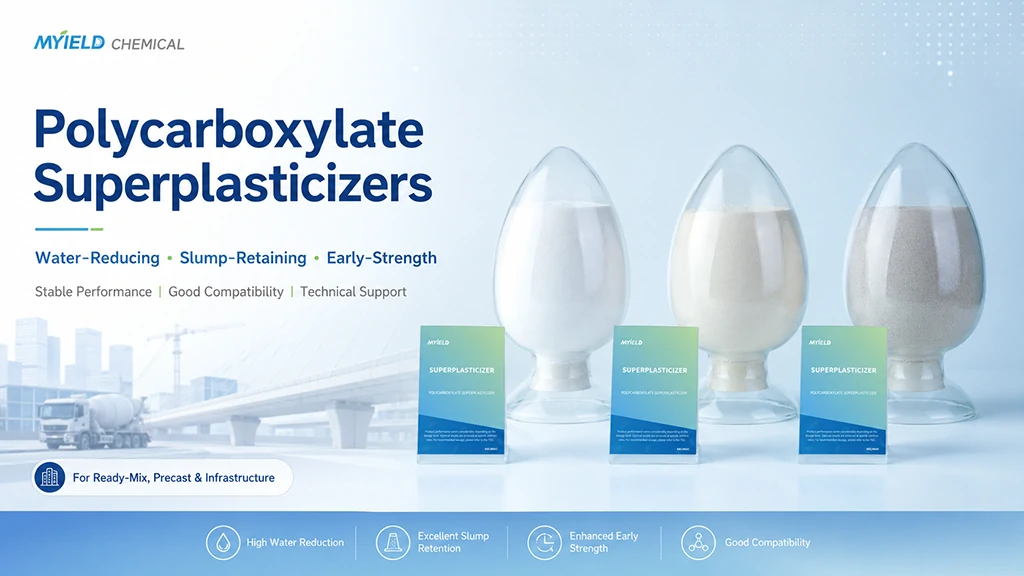
Water-reducing admixtures are among the most important chemical additives used in modern concrete production.
They reduce the amount of mixing water required while maintaining or improving concrete workability.
With a lower water-to-cement ratio, concrete can achieve higher strength, greater density, and improved durability.
Water-reducing admixtures are also considered an effective and economical way to optimize concrete performance.
2.2 Air-Entraining Admixtures: Protection Against Freeze-Thaw Damage
Air-entraining admixtures introduce numerous tiny, evenly distributed air bubbles into concrete.
These microscopic air voids help relieve internal pressure when water freezes, reducing the risk of cracking and deterioration caused by repeated freezing and thawing.
Air-entraining admixtures are particularly valuable in cold regions, hydraulic structures, and outdoor concrete projects exposed to harsh weather conditions.
They help improve the freeze-thaw resistance and long-term durability of concrete.
2.3 Retarding and Accelerating Admixtures: Controlling Concrete Setting Time
Retarding Admixtures:
During hot weather or long-distance transportation, concrete may begin setting before construction is completed.
Retarding admixtures delay the setting process, allowing more time for transportation, pumping, placement, and finishing.
They are particularly useful in hot-weather construction and projects requiring extended working time.
Accelerating Admixtures:
In cold weather or projects with tight construction schedules, faster setting or early strength development may be required.
Accelerating admixtures help concrete set or gain early strength more quickly, allowing certain construction operations to proceed sooner.
They are commonly used in precast concrete production, repair projects, and construction applications requiring rapid early strength development.
2.4 Expansive Admixtures: Helping Prevent Concrete Cracking
Concrete naturally undergoes shrinkage during hardening and drying, which may lead to cracking under restrained conditions.
Expansive admixtures produce controlled expansion during the early stages of cement hydration.
This expansion can help compensate for concrete shrinkage and reduce the risk of shrinkage-related cracking when the mixture is properly designed and cured.
Therefore, expansive admixtures are often used in projects where shrinkage compensation and crack control are important.
3.Common Mistakes When Using Concrete Admixtures
Although chemical admixtures can significantly improve concrete performance, they are not universal solutions.
Improper selection or application may negatively affect concrete quality and construction safety.
Avoid Improper or Excessive Dosage:
Concrete admixtures should never be added without proper evaluation. Incorrect dosage may cause abnormal setting, segregation, or other serious performance problems.
Control the Dosage Accurately:
The dosage of chemical admixtures should be carefully calculated, usually as a percentage of the cementitious materials by weight, according to product specifications and actual formulation requirements.
Conduct Compatibility Tests:
Not all admixtures are compatible with every type of cement or supplementary cementitious material.
Compatibility testing should be carried out before use to ensure that the selected admixtures provide the desired performance.
Conclusion
Concrete admixtures are essential components of modern concrete technology.
From improving workability and controlling setting time to enhancing freeze-thaw resistance and reducing shrinkage-related cracking, different admixtures perform specific functions in concrete production and construction.
However, achieving high-quality concrete requires more than simply adding chemical additives. Proper selection, accurate dosage, and compatibility testing are equally important.
The scientific application of concrete admixtures combines chemical precision with engineering performance, contributing to stronger, more durable, and more reliable concrete structures.
At Mingya Chemical, we understand the importance of chemical additives in modern construction materials and are committed to providing reliable additive solutions for different building material applications.